
Our friend texted our group chat, along with a photo of her swollen belly.
She wasn’t pregnant; she’s 51. And this wasn’t a food baby either.
For weeks, she’d been having trouble emptying her bladder completely, but like most of us, she kept pushing through. It wasn’t until she realized it had been almost 18 hours since she’d peed that she finally got to the doctor.
Turns out she had a fibroid the size of a grapefruit pressing down on her urinary tract.
Flash forward to weeks of catheter bags while she waited to get scheduled for a full hysterectomy. Have we mentioned our health care system is overworked?
Her experience got us thinking about how most women don’t know what fibroids are until they become a problem. So, here’s what you need to know:
What’s a fibroid?
Uterine fibroids are muscle tumors in your uterus – but don’t panic. While ‘tumor’ sounds terrifying, fibroids are not cancerous.
You can have a single fibroid or multiple. And fibroids can be microscopic to cantaloupe-sized. And as my friend discovered, when they grow large enough, they can press on nearby organs like the bladder, creating serious complications.
They’re pretty common; up to 80% of black women and 70% of white women will have one by age 50. Their impact can range from having no idea they exist to wreaking havoc on your well-being and quality of life.
Why do fibroids happen?
We don’t know. Like many female-specific health issues, we need more research. Fibroid-related symptoms are often dismissed as ‘part of being a woman’. And it can take years to get diagnosed. This needs to change.
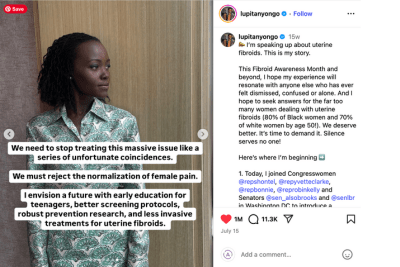
Fortunately, change is on the horizon thanks to influential women advocating and supporting legislative initiatives for fibroid research funding. We applaud actor Lupita Nyong’o for sharing her story of silently suffering before having 30 fibroids removed. Her voice is paving the way for better understanding and care.
What are the symptoms?
Small fibroids typically cause no symptoms and just need monitoring. Larger fibroids can cause:
- Heavy / painful periods
- Bleeding between periods
- Bloating or fullness in lower belly
- Frequent urination or difficulty emptying bladder completely
- Pain with sex
- Lower back pain
- Constipation or rectal pressure
- Ongoing vaginal discharge
- Abdominal swelling
How are fibroids treated?
Treatment becomes necessary when fibroids cause heavy bleeding leading to anemia, significant pain, or health complications like bladder issues. The type of treatment will depend on a variety of things including symptom severity, life stage, and personal preference. Fibroids can be treated with:
- Medications: like pain relievers (ibuprofen, acetaminophen), birth control to reduce heavy bleeding, or hormone medications to temporarily shrink fibroids
- Surgeries:
- Myomectomy – removes fibroids while keeping uterus
- Hysterectomy – removes entire uterus (what our friend had)
- Embolization or Ablation – different procedures that reduce blood flow to the fibroids.
- Note: with the exception of a hysterotomy there’s a high reoccurrence rate for these procedures, meaning the fibroids can grow back.
When to see a doctor?
Contact your doctor if you experience:
- Persistent pelvic pain
- Heavy periods that interfere with daily activities
- Bleeding between periods
- Difficulty emptying your bladder
- Pressure or fullness in your abdomen
- Painful intercourse
- Constant fatigue or weakness (possible anemia)
Seek immediate care for:
- Severe vaginal bleeding
- Sudden, sharp pelvic pain
- You haven’t peed in 18 hours
Want to geek out and learn more?
Check out this post by Dr. Jen Gunter. It covers everything from the theories on why fibroids happen to the treatment option details.
Look, we get it. We’re all busy and it’s easier to ignore symptoms than deal with them. But please don’t wait until it’s been a day since you’ve peed to take action.
Take care and we’ll see you next Thursday.
xoxo,
Mikelle & Michelle
