Episode Transcript
Speaker 0
Today's episode is one I've been looking forward to for a long time. If you've been following this as perimenopause, then you know that I've been absolutely raving about doctor Laurie Brodwell's book, Better Sex Through Mindfulness, for years. My copy is dog eared, full of stickies, and it's been a game changer for me. It's transformed the way I connect with my body, how I experience intimacy. It's helped me rediscover pleasure and desire, in a whole new way. I can't recommend it enough.
Speaker 1
No. It's true. And Mikel is obsessed with this book. She hasn't stopped talking about it for years. And I would say pretty much since we launched this podcast, doctor Brado has been on our wish list for guests for the show.
Speaker 0
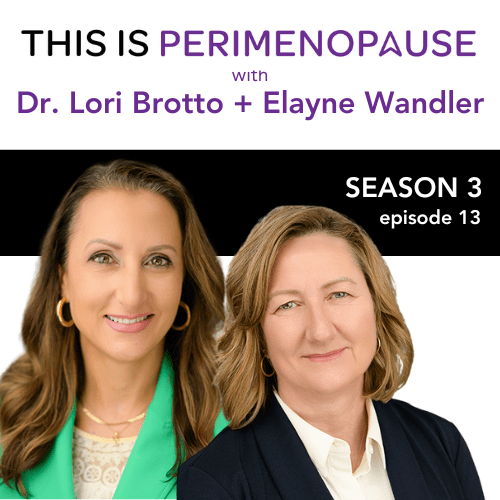
And today, it's finally happening. We're so excited and very honored to have not just doctor Brado joining us, but also Elaine Wandler, the CEO of eSense Health.
Speaker 1
Through her groundbreaking research and clinical work, doctor Brado is revolutionizing the way we approach women's sexual health.
Speaker 0
Elaine, seasoned life sciences executive, is leading the charge at eSense Health,
Speaker 1
a self guided digital program cofounded by doctor Brado and designed to help you take charge of your sexual well-being. Today, we're talking about why so many women in perimenopause have little to no desire, and more importantly, how to get it back.
Speaker 0
We're exploring the science behind mindfulness as a powerful tool for sexual well-being in overcoming things like low libido, disconnection from our bodies, and the ups and downs of our hormones.
Speaker 1
If you've ever struggled with sex, desire, or body image, I mean, well, this is perimenopause. But today, we're learning that we can have healthy, satisfying sex life and a healthier connection with our bodies even in perimenopause and beyond.
Speaker 0
The sexual health revolution starts now, ladies. Let's dive in.
Speaker 1
And now a word from our partners.
Speaker 2
Hi there. Volva speaking. We need to talk. For years now, you've been calling me the wrong name. I'm the vulva, not the vagina. I'm all the external bits you can see. My neighbor, the vagina, she's the internal tunnel connecting me to your uterus. You know, the baby highway. Different parts, different names. It's pretty hard to address dry, uncomfortable situations when you don't even know which one of us needs the attention. Now that we're properly introduced, can you please hook me up with some Iris? Their water based moisturizer and lube are exactly what I need. No irritating fragrances, just clean ingredients to keep me happy and well hydrated, not dry and disgruntled. Eternally grateful for the hydration and finally getting my name right. Signing off, x o x o, your vulva.
Speaker 1
And now that you've been properly introduced, do your girls a favor and use code t I p twenty for twenty percent off at love my iris dot com. That's t I p two zero at l o v e m y I r I s dot com.
Speaker 0
Welcome. We're so excited to have you both, doctor Brato, Emilie and Wandler. Lots of great questions. Let's get right into it and talk about sex and why so many women are not having it or are having it and not enjoying it. What can you tell us? What's going on?
Speaker 3
Yeah. Well, let's let's get right to it. Great great to be here and and always great to be talking about this pretty important topic. It's a fundamental part of quality of life. We know that when sex is dissatisfying or distressing that it filters into many different aspects of a person's life and well-being and happiness. So, and yet at the same time, there are cultural taboos that get in the way of us really talking about it. And those are magnified when it comes to women's sexuality and magnified even more so when it comes to midlife women's sexuality. So really, really glad we're talking about this. So first and foremost, important to know that sexual concerns in women are prevalent. They're about twice as common in women as they are in men. And among the various kinds of sexual concerns, low desire is probably the most common one. So low desire reflecting lack of interest in sex, lack of motivation, not initiating sex anymore, not responding to a partner's advances. And in fact, a lot of women that I see in my clinical practice will say, doc, if I never have sex again, I'd be quite okay with that. You know? I've got a great fitness routine. I've got my friends. I've got my fantastic dog. I really don't need this in my life. It doesn't sort of have any added value. And yet at the same time, there's this deep sense of suffering and and longing for for what used to be. Because for a lot of these women, they do recall a period of their life where they did engage and have fulfilling sexual activities. So, yeah. So, again, really important that, that we're having this conversation today.
Speaker 0
Amazing. What so maybe we can delve into what what's what are some of the causes? Why Why is this happening?
Speaker 3
Yeah.
Speaker 0
And maybe we can focus specifically on, you know, our age and stage, perimenopause, when when I believe it's very common for this to rear.
Speaker 3
Yeah. Yeah. So, thankfully, there has been a fair bit of research on this topic. Sadly, that research started after Viagra was approved in men in Canada in nineteen ninety nine. So it sort of ushered in this new wave of mostly female researchers who said, oh, great, we've got this blockbuster medication for men, it's safe, effective, treat, What about women? And and so really the start of quite fulsome sex research trying to understand these really complex constructs like desire and arousal and pleasure and anorgasmia has really only been in the last twenty or so years. So in terms of causes, researchers like to use the term biopsychosocial. And what that means is that there's probably, in most cases, a combination of biological factors, psychological factors, and social factors. So if we take low desire in midlife women in particular and we start with the biological factors, and that's that's usually really important to do first because sometimes it's a if it's a very obvious biological cause, maybe there's, exactly, maybe there's an existing remedy that can address that. So in midlife, we talk about genital urinary syndrome of menopause, so vaginal dryness, urogenital changes, urinary frequency and urgency, pain with sexual activity that for a lot of women is remedied by vaginal estrogen. Right? Not all, but for a lot of women. So that would be, like, one of the biological or more physical causes. There can be other things medically if the person's on a medication, if they have a co occurring medical condition that is getting in the way of arousal and desire from happening. But when we look on the whole with low desire, those biological factors don't contribute a a a whole lot. They contribute some, but they're not they're typically not the main reason why women have no or or have lost their desire in midlife. So then we kind of look at this big area of the psychological factors. Top of the list is stress. Right? The chronic, never ending to do list, the sense that I'm never catching up, the physiological effects. I'm not doing anything well. And then in midlife, there's all the co occurring changes that happen, memory changes, word finding problems, irritability, difficulty sleeping. Right. It's being woken up from relentless night sweats and on and on and on. And so those psychological factors become really, really important for us to address. And as a psychologist myself, that's where we can take our evidence based treatments and actually do a lot of really good work with women. And then I'll touch on just really briefly the social factors. So this is, you know, what's happening in the relationship.
Speaker 4
Mhmm.
Speaker 3
There's some reports out there that, you know, menopause is, associated with a spike in divorce rates. Now does menopause cause divorce? No. But it is a period of life where women are saying, it's time to refocus on me. It's time to shed the things that don't serve me, that are holding me back. And and so we do see an increase in separations around around that midlife time. And then there can be social explanations in the way of the person's cultural background, their religious beliefs, what they see on TV, and all those messages that feed into their norms of what is, quote, normal sexuality.
Speaker 0
Great. Great answer. Yeah. Doctor Barato, you've written a book that, I absolutely love and I've been raving about since I read it. And it's been described as a groundbreaking approach to improving sexual desire. And it's called Better Sex Through Mindfulness, my very dog eared copy here. I would say I am not a mindful person yet. I am working on it, but I was fairly skeptical when I got my copy. You hooked me in in the first chapter with Shalena's story, and I have to say the impact it's had on my sexual well-being has been significant significant. So wondering maybe you could tell us a little bit of a little bit about the, you know, what I'm very what what I'm trying to say very inarticulately, which I think you've discovered in your research, which is essentially the the surprising benefits of mindfulness applied to sex.
Speaker 3
Yeah. Yeah. So, you know, writing the book was really an attempt to take the science, which had been mounting for a number of years. And in fact, even before I started doing research on mindfulness and sex in two thousand and two, there had been twenty, thirty years of mindfulness in its application to things like chronic pain, general stress, depression, anxiety that was telling of a very compelling story. And the story was that by tuning in nonjudgmentally, it fundamentally changes it our brain, both how our brain functions in the moment and over time structurally. So with repeated practice, it actually alters how the different parts of our brain communicate with one another. And when that happens, the outcome is fundamental changes in our physiology, how we feel, what we think, how we cope. And and so one of the hard facts I had to grapple with as a scientist was the fact that people don't read the science. You know? Like, what we output stays buried in journals Mhmm. Behind a a paywall, and the general public doesn't benefit from all of these wonderful discoveries. And so writing a trade book was was a way of taking the science and ensuring that it would land in the hands of women so they could benefit from it. And so that's what the first book, Better Sex with Mindfulness, was really intended to do. And all I was was a storyteller, so sharing the stories of some of the women that I'd seen in my practice who had reluctantly and skeptically tried mindfulness. Shalena was one of them, and and just sharing their experiences throughout and then weaving in some of the scientific findings. And then a few years later, I, wrote the sort of companion treatment manual, which is, okay. You're interested. Now here's how you do it. And so the the follow-up book, the the the treatment manual actually walks people through it. But the instructions are are fairly simple. Pay attention
Speaker 4
Mhmm.
Speaker 3
On purpose, non and nonjudgmentally, but it's not easy. So it's a simple set of instructions, but certainly not easy. And it's you know, there's lots of reasons for why it's not easy. I mean, we live in a world that just prizes and rewards multitasking and speed and getting to the next place and doing multiple things at once. And the part of the offshoot of that is that women then take that way of being into their sexual encounters.
Speaker 1
Mhmm. Mhmm. Yeah. Like
Speaker 3
And it doesn't work.
Speaker 1
This is like It doesn't work. For me, for many not so much anymore, but for many years, it was just another thing on checklist that, like, okay. Well, it's it's getting to the end of the week, and it's been a week and a half, and we should we should do this.
Speaker 3
Yeah. Yeah.
Speaker 0
Yeah. And then you're thinking about the grocery list and the whatever lessons and the yeah. Yeah. Not so sexy.
Speaker 3
Not so sexy. Did I shut the oven door the oven? You know? Yeah. Like, not so sexy.
Speaker 1
Yeah. So I don't wanna jump around too too much, and I do wanna put a pin back and go back into my fullness. But your books led to this new venture with Elaine. Is that is this what is this what led you to eSense and the bringing together of these two fabulous women? Can you tell us a little bit about eSense?
Speaker 3
Yeah. I'll I'll start with with, kind of the transition and then, yeah, turn it over to Elaine. So this started in a conversation with my cofounder, Kyle Stevenson, who's at Xavier University. And Kyle and I had known each other for quite some time at scientific conferences, and he's much more of an expert in cognitive behavioral therapy. And we had this conversation around this kind of dilemma that we both were seeing in our clinical practice and also in research, which was that, you know, the field has these great treatments. Why are people not aware of them? Why are they, you know, going to doctor Google and paying for expensive supplements? And so that kind of started this what we thought originally was gonna be just a small side project around taking these evidence based treatments. So the mindfulness work that I had developed and then cognitive behavioral therapy and putting it together in a digital tool that was accessible, that used language, that was very friendly and understandable and relatable to women, and that was really intended to mimic what would happen if a woman were to see a registered psychologist or sex therapist for low desire. So that was sort of the early days of ESENSE.
Speaker 1
Love that. And and how did Elaine, how did you get involved?
Speaker 4
I mean, Laurie and Kyle have done all this work for really the last decade. And so they brought it now where it's close to market. And so it fits well with my background, which is commercializing life science inventions. And so they brought me in last year to sort of lead that commercialization effort. So, I mean, I would say the mission of the company is so important. You know, Laurie talked about how prevalent these concerns are with women. You know, there's over forty percent at some point in their life have sexual concerns yet less than twenty percent of those get help. There's all kinds of reasons for that. You know, stigma, lack of awareness, shortage of specialists, and geography. So ESENSE was really the venture to close that gap and to empower women to take control of their own sexual health by providing accessible evidence based care.
Speaker 1
And so is it like, a Felix Health or something? One of those online women's health platforms where you connect with a psychologist? I don't No.
Speaker 4
It's it's different than that. ESense is actually a private self directed digital platform that delivers this evidence based care and was designed specifically for women. So as Laura mentioned, we took those gold standards and treatments. So cognitive behavioral therapy or CBT and mindfulness based therapy, and then transform them into two eight module programs that can be done over a period of say ten to twelve weeks. So women do it on their own. There's no wait list. There's no waiting rooms or awkward conversations.
Speaker 1
And also, some women are intimidated or or don't wanna talk about sex or maybe they have been brought up to think that wanting sex or wanting to improve their libido might be bad, it might be wrong. And so this might this is a great because it's not incognito, but it's a little bit there's there's some privacy to it as well, which is amazing. Yeah.
Speaker 4
I mean, I think it addresses most of the reasons why there is this gap in care. Right. So stigma being one of them, events and costs, you know, here, you can actually get clinically grounded care that's accessible anytime, anywhere and for a fraction of the cost as well. So it does hit a lot of those points. Amazing.
Speaker 0
And is there access to clinicians through the tool or is it program based with videos and, and modules?
Speaker 4
Yeah. It's program based. So the program itself is the self guided, which a lot of women really like, as you mentioned. Yeah. But we also offer optional navigator support. So these are trained navigators or trained personnel who check-in help women stay engaged, answer questions about the program. So they're not therapists, they're not providing therapy. But they do provide encouraging, encouragement and accountability, which is nice to have when you're doing something on your own.
Speaker 1
Accountability is key. Right? Because I can tell you how many programs I've paid for and started and maybe haven't finished. So that's lovely that there is that aspect as well. That's fantastic.
Speaker 4
I'm with you I'm with you on that. And longer term, there might be, you know, we're not we're keeping the door open in terms of whether there will be clinician access for certain cases and certainly can be done done as an adjunct to someone that's getting clinical care now as well. For sure.
Speaker 0
Yeah. That's fantastic. You're you're not live yet, though. You've done trials. Am I understanding that correctly? And you haven't launched.
Speaker 4
Yep. Yep. We have great clinical evidence, but so what we're doing right now is running a commercial pilot. Mhmm. So there's still limited access. So we're working with, select clinics and also women that have been on our wait list. Our our broader launch is planned for the second half of twenty twenty six. But Okay. Great. Yeah, we're trying to be intentional just to make sure that the experience and support and everything is perfect before we open it up more widely. And so I would say the best way to, for your listeners to maybe stay up to date or potentially access ESENSE through a clinical trial or through the pilot as it opens up is to join our mailing list.
Speaker 0
Great. We'll include that in the show notes.
Speaker 1
Yeah. Absolutely. So so one of the techniques people are gonna be learning about in eSense is mindfulness. And my understanding is that, the idea behind mindfulness is to help us develop the ability to be in the moment so that we can notice if we are in the mood. If we're aroused, if there's something good happening. So it's training the brain to stay caught in the here and now. Can you share, like, some simple mindfulness practices that listeners maybe could try at home or maybe a part of the eSense program?
Speaker 3
Yeah. Yeah. Why don't we do this right now? I'll invite you all right now
Speaker 4
to Okay.
Speaker 3
Get into a comfortable position in your chair, whether you're sitting or standing, close your eyes. And just as we get started, take a few deep breaths. And just notice as we're settling into where we're sitting, where the mind is going. Maybe it's thinking about the conversation, the next question, later on today, and just see if you can gently guide that attention back onto the sensations of breathing, noticing the cool air as you breathe in and the slightly warmer air as you breathe out. So not changing the breath, not trying to breathe deeper. Just bringing an awareness to the breath exactly as it is. And as you're doing that, again, the mind is probably gonna take off because that's the nature of what our minds do. And that's a moment of mindfulness when you notice the mind has taken off off and you can say, there you go. Come back and get me back.
Speaker 1
That's the moment of mindfulness?
Speaker 3
That's the moment of mindfulness. My
Speaker 1
God. You that's That's the mindful moment. I'm back. Oh, my God.
Speaker 3
Okay. So that was short.
Speaker 0
Wait. I didn't even go ahead. I have
Speaker 1
seen Michelle. Go ahead. You blew my
Speaker 3
And and Michelle, that's such an important point because often what what women will say to me is, I can't do this. My mind takes off a thousand times. And then I'll say, well, what do you do when your mind takes off? And they'll say, well, I notice it takes off, then I bring it back. And I'm like, you're doing it. That is mindfulness.
Speaker 1
No. It looks I like
Speaker 3
this is It's when we let the mind go down the many rabbit holes untethered, and then it goes to judgment land and processing land and everywhere else that we got in get lost in mindlessness. But when we catch the mind that is taken off and bring it back, that's mindfulness. And then the second part of that is we bring a certain amount of kinda compassion to our mind and say, well, of course, this is what our mind is gonna do. I always make analogies to my dog because I no matter how bad she is, I never get mad at her. And I say, you know, my dog takes off all the time. I've spent all this money on training, and she just keeps taking off. And I don't yell at her. I just say, well, of course, she's gonna take off. She's a young black lab. That's she's curious, and I gently guide her back. And so I use this analogy on on ourselves that we can use towards our minds. If we just accept that this is the nature of our mind, and in fact, everything in society today promotes that escape and being curious and being pulled here and there, then we can say, there you go. Come back. And that's the moment of mindfulness. K.
Speaker 1
I'm so sorry. I did not mean to interrupt that very zen moment. That was so lame. You you blew my mind. Like, I was like, oh my god. I'm the most mindful woman in town. I'm like, like, seriously, I'm doing it alright. My gosh. Thank you. Sorry. So do Well, I'm gonna try another one. Try again?
Speaker 3
I think your listeners probably got got the gist of it. Right? Which is paying it we use the breath as an anchor in this one.
Speaker 1
Mhmm.
Speaker 3
But in general, mindfulness practice and certainly folded throughout essence, we start with an eating meditation using a raisin, then we fold on move on to a a a brief body scan, which is noticing the different parts of the body and the sensations and the breath, then we do some movement. So there's a video in eSense where you'll see someone from our team who's doing what looks like gentle stretches, and we call it mindful movement where they're, again, paying attention to the movement of the body nonjudgmentally. And then we move on to the really challenging practice, which is called mindfulness of thoughts. And this is the ability to just sit back from a distance and watch the nature of our thoughts. So it's not getting caught up in the content, but it's being able to say, I'm having a planning thought, I'm having a memory thought, I'm having a judgment thought. And that sense of being able to see thoughts as separate from ourselves, thoughts don't define us, nor are thoughts truths. Thoughts are a byproduct of what our brain does.
Speaker 1
Right.
Speaker 3
Right? And for women with low desire, that is also such a critical piece of learning because when they start to have thoughts like, I'm broken, I'm not normal, my partner should just leave me, they take these as facts
Speaker 1
Mhmm. Mhmm.
Speaker 3
And prescriptions on what to do to do next. And so mindfulness in this case can be really helpful because they can just see these as, you know, what the brain is doing. It's the brain's way of kind of processing the current distress of the moment, and there's a lot of kind of sense of comfort in in realizing that thoughts don't define us.
Speaker 1
Love what you're hearing? Don't miss our weekly newsletter. It's got expert advice, evidence based resources, practical tips, and, of course, a little humor.
Speaker 0
Go to this is perimenopause dot com to subscribe and join the thousands of women who have realized they need and deserve better. I think, as you said, simple but not easy. Yeah.
Speaker 4
And I
Speaker 0
think the research, probably a lot of your research in particular, has shown that distraction, and or the inability to be present is way more important when it comes to female desire. But a lot of treatments are actually working towards facilitating, or putting more gas, more fuel on the fire when they're not addressing the brakes,
Speaker 4
which
Speaker 0
is what so maybe can you tell us a little bit about the gas pedal and the brakes and
Speaker 3
Yeah.
Speaker 0
Responsive versus
Speaker 4
Yeah.
Speaker 0
Spontaneous desire? Because I think that that trips up a lot of women.
Speaker 4
Yeah. Because what we see
Speaker 1
on TV and in the movies is spontaneous desire.
Speaker 3
Yeah. It well, it's not realistic. It's not factual. It's not it's not based in evidence or experience. For most people, most of the time, there's isolated instances. So this kind of notion, the romantic notion of this innate feeling that comes within you of craving and wanting, and that craving and wanting leads you to seek out a sexual encounter. And then you get aroused, and then you have an orgasm, and then that's the end, full stop. And that's this picture of spontaneous desire that's very linear, and it suggests that desire comes first. And that might be the common experience for people and women in a new relationship where everything is novel, and it's very dopamine driven, the part of our brain that that holds the reward centers. But what happens over time in a in a slightly longer term relationship is things are not novel. There's routine. Spontaneity doesn't exist anymore. It gets replaced with planning and intention, and then you layer on life and stress and obligations and other feelings, etcetera. And it becomes really important for us to think about and and really lean into a different kind of desire, and it's a desire, that my my former mentor, Rosemary Bassan, wrote a lot about in two thousand called responsive desire. And doctor Bassan was not the original kind of initiator of this idea. Helen Singer Caplan and others, actually back in the seventies, had talked about this, but I think, Bassan really wrote about this in a very articulate way based on the patients she was saying and essentially, states that for people in longer term relationships, they engage in sex for a reason. And it turns out there's about two hundred and thirty seven distinct reasons, and that's come comes out of other research that folks from the University of of Texas have done. But the reasons might be, I want to connect, I want to celebrate a birthday, I want to have an orgasm, I want to get to sleep, I want to feel normal, also my partner's birthday, I feel of sort of a sense of I have to. So there could be many, many reasons, and hopefully those reasons are positive reasons, what we call approach reasons about getting something good.
Speaker 1
Mhmm.
Speaker 3
And we but we do know that there are many women that engage in sex for what we call avoidance related reasons, to avoid something bad, to avoid conflict, to avoid a belligerent partner. That's a signal for couples therapy. Right? Yeah. Yeah. Practicing mindfulness or CBT or other strategies is not going to resolve. That's a signal of much deeper relational problems in a situation where sex is being used as a manipulative tool. Mhmm. So let's assume that we're in a situation where the woman's feeling totally neutral, doesn't feel desire at all, but she's got a good reason. And then the kinds of exchanges that happen after that, the stimuli that she's exposed to are right for her. And this means what are the touches that partner is doing? What's the environment around her that work for her at that stage of her life? And really important to know what works for you as a midlife perimenopausal woman might be very different than what worked for you at twenty or at eighteen or at thirty five. And so this becomes a lot of the conversation that we have in sex therapy as well that is also talked about in essence. So we've got this sort of combination of reasons. So you start neutral, reasons, good sexual cue, the right sort of context. You're not worried about kids walking in or dog barking at the door or other intrusions. And then the brain takes over. The brain takes all of this information and essentially turns that and makes a decision if it's going to elicit arousal or not. Now I haven't said desire anywhere in this conversation yet. Arousal is the first point. And so if arousal happens and if all those checkboxes are in place, arousal will happen, it's a it's a relatively reflexive reaction, then that will pave the way for the wanting. And so, typically, what this looks like in a kind of real life scenario is a woman who says, yeah. I was kinda neutral at the beginning. I went into it with first some good reasons. I want to connect. I realized it had been some weeks. We engaged in the right kind of touching that worked for me, which is kind of a slow kindling, slow and steady, got the right lube in place, could stay focused. My body started to respond. And then suddenly, I was like, oh, wow. This feels good. I want this to continue. And we call that responsive desire. It's desire that emerges in response to arousal. And it turns out this pattern of neutral to arousal to desire is far more common than we talk about, and it's especially characteristic of long term relationships and women in particular.
Speaker 0
Yes. So take note, everyone listening Yeah. You are normal.
Speaker 3
You are normal.
Speaker 4
And then
Speaker 1
I was just thinking, can you, like I'm just losing my words, but could you, like, help a screenplay writer to write that into one of his movies instead of, like, what my husband sees? Like because the men are seeing these women, like, with spontaneous desire, and they still believe that that's still the thing even
Speaker 3
I know.
Speaker 1
This late in the game. So Yeah. I don't know. Yeah. No. This is fascinating.
Speaker 0
Maybe you, Elaine, maybe you could, develop or map out a plan for a an adjunct program for men For men. Specifically.
Speaker 4
Yeah. How to understand
Speaker 0
the response of desire.
Speaker 1
No. Stop. That's a great idea.
Speaker 4
It is a great idea.
Speaker 1
Because we're only one half of well, you know, unless we're in a
Speaker 3
same sex. Yeah.
Speaker 1
Yeah. Like, we're only one half of the equation. That's really clever. Next million dollar idea.
Speaker 3
Yeah. Yes.
Speaker 4
Cha ching. I made notes.
Speaker 0
I'd love to to just delve into both of your backgrounds a little bit. They're both very impressive, you know, and kinda get at why sex. So maybe we'll start with you, doctor Barrado. How did you you've mentioned you've been doing this for a very long time, since two thousand and two, I think you said, the research component. You also have a clinical practice. You also work at UBC. Is that
Speaker 3
Mhmm. Correct? Yeah.
Speaker 0
Why why sex, and why did you become a sex researcher?
Speaker 3
Yeah. Well, we have to go way before two thousand and two. I, did, research studying rats having sex in, nineteen ninety three. So I was a, you know, young undergrad desperate to get research experience, and the only professor in psychology that would take me because I was so young, and I didn't know it at the time. I was mostly interested in depression and wanted to be a depression focused psychologist. Didn't even think about research. The only person that would take me was someone who was studying animal models of sexual behavior. So I spent about six years in a tiny little room by myself, moving picking up rats by the tail and moving them into different chambers and injecting them with the stress hormone, corticosterone and, fussed.
Speaker 0
Spike Michelle's stress hormones talking
Speaker 3
about picking up strobe lights flashing strobe lights on them to stress them out Okay. And then looking at the impact on their sexual behavior. And, I think what it really introduced to me was well, number one, that I don't wanna spend I don't wanna spend any more years in a tiny little room because I would leave smelling like the rats themselves first and foremost. But it it really grounded me in the scientific method, how in when we do animal research, nonhuman animal research, we can really sort of control these factors. I knew exactly the dose of stress hormone I was giving them. I could count exactly the number of mounts and intermissions and the ejaculatory period, etcetera. And, and I I sort of fell into sex research that way. And then, made the switch to human research in nineteen ninety nine, coincidentally, was the year Viagra was approved in Canada. And it actually wasn't a coincidence. It was all the news on Viagra led me as a, you know, young PhD student to say, what do we have for women? And I took to the scientific literature search and discovered that there was nothing comparable. There was very little science understanding female sexuality. And in fact, it started making me think about the six years of research that I was doing. So my professor was looking, trying to understand female sexuality and we were using male rodents. And it was so that we could sort of control the oestrous cycle and so it just flipped the switch for me, and I also then became very interested in gender equity issues in health research, which paved the way I didn't know it at the time for the leadership role that I held for the next ten years, leading a women's health research institute to try and channel funds to women's health research and elevate women's health researchers and do all that. So there's a little bit of my history, not a straight line for sure.
Speaker 0
Amazing. Well, thank you for Yeah. We're we're all benefiting from you happening to fall in with those rats. So thank you for everything that you do. And, Elaine, how about you? Why was ESENSE the next step in what is a very impressive health sciences career?
Speaker 4
First, I wanna say it's always fun to hear those early science and research stories. We all have them. I don't eat ground beef for a reason, but I won't go there now. But I've had, yeah, over the years, you know, I've brought lots of scientific discoveries to market and it's always super satisfying to sort of give patients access to treatments that make a difference in their life. The majority of my career has been in drug discovery where data is king. Right. So that's, what's ingrained in me. I need to see actual evidence. And so what attracted me to eSense was not only was it based in clinically sound treatment protocols, but it was proven to be effective in clinical trials. And I love the rigor that Lori and Kyle were putting into testing it. So it's not going through any kind of regulatory approval, so they didn't have to, but it's who they are and what's important to them as researchers. And so that was a definite alignment. Their credibility on top of that played a role. It's an honor to work alongside them. And, and that the huge unmet need and the lack of health equity. So all those components played a role in making this a great opportunity. So I'm super excited to be part of it.
Speaker 1
And and you just published, right, in in April, was it the, the randomized clinical trial? Is that when the results came through?
Speaker 3
Yeah. Yeah. So there we've had a number of publications come out from the work, but the main randomized trial that showed us what are the different domains of well-being, sexual well-being that ESENSE was really tapping into. And so it was a large study. We had a control group. We compared both the mindfulness and CBT arms. Not surprisingly, women in both arms, mindfulness and CBT, did very, very well. Okay. And they maintained their improvements when we reassessed them several months later. High rates of engagement, you know, most of them did the homework and the exercises. And then what we've been doing since then is we've been adapting ESENSE to particular subpopulations where we know that there's even higher rates of sexual problems. So we've, we've just finished over the last year trial adapting ESENSE to gynecologic cancer survivors, and we're just waiting for the last of the data to roll in now. So we worked with a a group of cancer survivors to adapt ESENSE. So there's entire sections on the different ways that cancer and its treatment impact, sexual response. The three cases in ESENSE are all cancer survivors with unique stories. And then we're working on other adaptations. We're just about to, launch an another adaptations for women who primarily have vulvovaginal pain, whether it's in the context of a diagnosis of vulvodynia, which is a chronic pain condition. But we also know a lot of midlife you know, eighty percent of midlife women have general urinary syndrome of menopause.
Speaker 4
Mhmm.
Speaker 3
And, again, topical estrogen, vaginal estrogen is is frontline gold standard treatment. And for some of those women, they have ongoing pain. And so the question of, you know, can ESENSE play a role in filling filling that gap for them. So, yeah, certainly over the next year, a couple of years ahead, we're gonna be looking at some unique adaptations to other populations. We we sort of know clinically that this is a tool that can be helpful for all women. But, again, going back to my and Kyle's kind of scientific grounding, it is really important that we'd be able to say, well, here's what the the data actually say.
Speaker 1
Is it is it a combination a combination of CBT and mindfulness, or is there different like, can I choose?
Speaker 3
Yeah. There's you can choose. There's there's different arms. And for some women, they may not know. They might say, well, help me decide.
Speaker 1
Well, I've heard that CBT is a little bit more work, like, it's a little bit of work. So if I wanna be lazy, can I go down the mindfulness route? Is that
Speaker 3
is Mindfulness is simple, but not easy.
Speaker 4
But not easy. So it's
Speaker 3
it's different. They're they're different. And, you know, one of the ways to know is if if you've if you've had a history with you know, have you done CBT for depression and done really well? Then maybe you'll wanna do the CBT arm. Or have you joined a mindfulness group for management of chronic pain and done really well? Then maybe you wanna do the mindfulness arm. So for the commercial pilot, we have some guiding questions embedded in the platform to help women decide.
Speaker 4
Okay.
Speaker 3
If you're if you're, you know, more analytical and problem solving and like to use evidence and, like, things structured, CBT might be a good fit. If you lean more towards mind body approaches and awareness and holistic approaches, mindfulness might be the better approach for you. But, again, going back to our large trial, women did very well in both arms.
Speaker 1
And and I would say, Mikel, you probably do the CBT and I would do the mindfulness if I had to hazard a guess. But you did love the book, you know?
Speaker 0
You know, the the I can't say enough about the impact of mindfulness application to have it.
Speaker 1
It was one of her first blogs, actually. She reviewed your book as well. Yeah. Yeah. Like Wow. Yeah.
Speaker 4
Yeah. So It
Speaker 0
what was it? Mind blowing. So Well done you. Well done
Speaker 3
done you. And it said, actually, that that was one of the early titles that I was considering, but it it just feel a bit too. Yeah. My mind blowing sex was one of the first titles of the book that I was contemplating, and it
Speaker 0
The next one. The next one.
Speaker 1
Made it well,
Speaker 3
I mean, it felt a little bit unscientific, but anyways,
Speaker 1
apparently, that's fair. Elaine, am I correct? You just won ESENSE just won the most innovative women's sexual health platform for twenty twenty five. Is that is that correct?
Speaker 4
Yeah. Yeah. That was by, Global Pharma and Health. Yeah. Thank you.
Speaker 1
That's amazing. And and the platform's not even it's still in beta right now.
Speaker 4
Not even fully out there yet.
Speaker 1
Wow. So Yeah. Ladies Very
Speaker 4
exciting. Gonna
Speaker 1
be amazing.
Speaker 0
Keep us posted. We'll be very happy to promote it through our
Speaker 3
Thank you.
Speaker 0
Networks and Yeah. Channels and what have you. That's that's amazing. Maybe we'll just finish things off, and ask each of you, what's one thing you would like every woman to know about their sexual health?
Speaker 4
I think for me, it's, that struggling doesn't mean something is wrong with you. I mean, I had a friend when I told her, you know, about this opportunity when I first started and she's like, I just thought women didn't like to have sex. And so it's kind of crushing. Right? And so it's. And this opportunity also gives the chance to do these podcasts where you can educate women and let them know this isn't normal. They don't have to suffer. It's a real issue. You know, don't take being dismissed, and there's actual things that you can do about it that really help and can overall increase your quality of life.
Speaker 3
And I think I would say for for women in particular that sexual health does not have an expiration date. And in fact, we can look forward postmenopause when we maybe have fewer concerns to give, and things like that at long term sexual satisfaction. And so it invites us to think about, you know, how do we redefine sexual satisfaction in a way that's really meaningful for us that isn't dependent on frequency of sex or intensity of orgasms. And so I think it's a really inspiring message that sex can get better with age.
Speaker 1
Mic drop. Thank you. That's amazing. Thank you. It's it's been such a pleasure.
Speaker 0
Yeah. It's been great. Thank you so much. Thanks so much for listening to the show.
Speaker 4
If you like what you hear, please subscribe and write a review.
Speaker 1
So more women can find us and get a better understanding of what to expect in perimenopause.
Speaker 0
This information is not intended as medical advice. The intent of this information is to provide the listener with knowledge to support more efficient and effective communication with their medical provider.